
Introduction
The Exponential Moving Average is a foundational tool in technical analysis. Its ability to weigh recent price action more heavily makes it highly responsive and reliable, particularly in the fast moving cryptocurrency market. Unlike a simple moving average, the EMA adjusts to market shifts more quickly, helping traders respond to momentum changes and trend direction with confidence.
In crypto, where volatility is constant, EMA based strategies provide a critical edge. Whether applied to Bitcoin, Ethereum, or altcoins, EMA trading strategies are used by professionals for both short term and long term market participation.

Why Use EMA in Cryptocurrency Markets
EMA is not just a trendline, it is a dynamic indicator that adapts to price behavior in real time. In the context of crypto, EMAs serve multiple functions.
- Trend Identification: EMAs help traders identify the current market direction. When the price stays above a rising EMA, the market is considered bullish. When it stays below a falling EMA, the market is bearish.
- Momentum Confirmation: The slope of the EMA offers insight into the strength of the trend. A steep upward slope suggests strong bullish momentum, while a flattening line may indicate weakening interest.
- Signal Generation: EMA crossovers, where a short term EMA crosses above or below a long-term EMA, are used to trigger entries or exits. These signals are particularly valuable in trending markets.
- Dynamic Support and Resistance: In active trends, EMAs often act as support during uptrends and resistance during downtrends. Traders use these points to re enter or add to positions.
Core EMA Strategy: The Crossover Method
One of the most widely used EMA strategies involves the crossover of two EMAs:
- A short term EMA such as the 9 or 12 period
- A long term EMA typically the 26 or 50 period
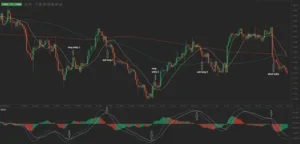
A buy signal is generated when the short term EMA crosses above the long term EMA, indicating that bullish momentum is building. Conversely, a sell signal occurs when the short term EMA crosses below the long term EMA, signaling potential bearish momentum.
This strategy is effective on multiple timeframes. For short-term traders, a 15 minute or 1 hour chart may be appropriate. For swing or position traders, 4 hour and daily charts offer a broader perspective with reduced noise.
Advanced EMA Trading Variations
Professional traders often refine the basic crossover system by integrating EMA with additional tools.
- EMA with RSI Confirmation: In this method, traders wait for a crossover signal and then check if the Relative Strength Index supports the momentum. A crossover plus an RSI reading below 30 can confirm a buy. Above 70 can support a sell.
- EMA with Price Action Signals: Price patterns such as bullish engulfing candles or breakouts from consolidation are used alongside EMA alignment to add context and strength to a trade setup.
- EMA Trend Continuation: Rather than entering on the crossover, some traders wait for a retest of the EMA after the crossover has occurred. For example, if price breaks above the 20 EMA, a trader may wait for a pullback and a bounce from that EMA to confirm continuation.
- EMA Golden Cross and Death Cross: The Golden Cross occurs when the 50 EMA crosses above the 200 EMA. It suggests a long term bullish trend and is often used for investment positioning. The Death Cross, where the 50 EMA moves below the 200 EMA, indicates bearish conditions.
Practical Considerations and Risk Management
Every trading strategy requires disciplined execution. EMA based strategies are no different. Here are essential guidelines for successful implementation.
- Use Protective Stop Loss Orders: Always place stop loss levels below key EMAs in long trades or above them in short trades to minimize risk from false breakouts or sudden reversals.
- Avoid Choppy Markets: EMA strategies are most effective in trending environments. Sideways or consolidating markets can lead to whipsaw signals. Use other indicators like ADX or volume spikes to filter such conditions.
- Scale into Trades: Rather than going all in at one crossover, consider adding to your position incrementally as the trend confirms itself.
- Backtest and Adapt: Different crypto pairs have different volatility profiles. It is essential to backtest the chosen EMA parameters on the asset and timeframe you plan to trade. Some traders adapt the periods based on asset behavior.
What is EMA in crypto trading?
EMA stands for Exponential Moving Average and it helps track the average price of a crypto asset by giving more weight to recent data.
Why is EMA better than SMA for trading
EMA reacts faster to price changes compared to SMA, making it more useful in volatile crypto markets.
What is an EMA crossover strategy?
It involves using two EMAs where a buy signal is triggered when the short EMA crosses above the long EMA and a sell signal when it crosses below.
Which EMA periods are best for crypto trading?
Common pairs include 9 and 21 for short term, 12 and 26 for swing trading, and 50 and 200 for long term trend analysis.
What is the Golden Cross in EMA trading?
It occurs when the 50 EMA crosses above the 200 EMA, signaling a possible long term uptrend.
What is the Death Cross in crypto?
The Death Cross happens when the 50 EMA falls below the 200 EMA, suggesting a bearish market outlook.
Can EMA be used on any timeframe?
Yes, EMA works across all timeframes from one minute charts to daily and weekly, depending on your trading strategy.
Should EMA be used alone?
No, it is best combined with tools like RSI, MACD, or volume to improve signal accuracy.
Is EMA good for day trading?
Yes, short EMAs like the 9 and 21 periods are commonly used by day traders for quick decision making.
How do I avoid false signals with EMA?
Use confirmation tools, avoid trading during low volume, and trade in the direction of the dominant trend.
Final Thoughts
EMA trading strategies offer a clear, disciplined approach to navigating the volatility of cryptocurrency markets. Their strength lies in their simplicity and flexibility. By combining EMA crossovers with supporting indicators like RSI, MACD, and volume, traders can create reliable systems that deliver consistent performance.
However, EMAs are not magic. They require experience, judgment, and rigorous risk management. They work best when viewed as part of a broader strategy built on structure, confirmation, and price action awareness.
Whether you are a beginner looking to understand market trends or a professional seeking refinement, EMA strategies remain a core tool in any serious trader’s toolkit.