
Introduction
Natural Language Processing NLP has undergone dramatic evolution from rule based systems and lexicon driven methods to statistical models, neural networks and deep learning architectures. In the influential survey Jumping NLP Curves, the authors borrow a concept from business and management, jumping curves, to conceptualize how NLP research progresses through overlapping phases. The paper argues that future strides will move NLP toward true natural language understanding.
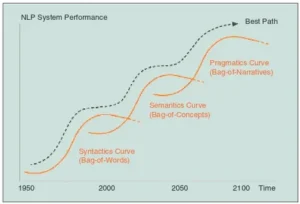
The Curves Framework Syntactics, Semantics, Pragmatics
The core contribution of the paper is its model of three overlapping curves through which NLP research evolves:
- Syntactics Curve: Early focus on grammar, part of speech tagging, syntactic parsing, rule based systems
- Semantics Curve: Shift to meaning, word embeddings, semantic networks, distributional representations of words
- Pragmatics Curve: Moving toward context, discourse, narrative understanding, language grounded in world knowledge
The authors argue research is now approaching the intersection of these curves, a point at which systems can move beyond individual words and syntax toward full meaning and contextual discourse.
Historical Development of NLP According to the Paper
The review traces the progression of NLP research:
- In the early decades, NLP centred on syntactic analysis, rule based systems and symbolic representations
- With growing data and computational power, there was a shift toward semantics, including word embeddings, vector representations and distributional models
- More recently, the authors propose that research is advancing into pragmatics and narrative understanding, including tasks involving discourse, story comprehension, sentiment and common sense reasoning
According to the jumping curves analogy, NLP research jumps from one dominant focus to the next as problems saturate and new demands arise.
Key Insights and Themes
- The paper highlights that while syntax and semantics remain important, the real breakthrough lies in integrating context, world knowledge and user intent
- It emphasises that sheer processing power or large corpora are not by themselves sufficient, what is required is a deeper understanding of meaning and pragmatics
- The authors point out that despite significant progress, we are still far from true natural language understanding, as machines often struggle when language shifts domain, style or context
Implications for Current NLP Practice
- For practitioners, the paper suggests that focusing solely on word level embeddings or syntactic parsing may no longer suffice, and attention must shift toward contextual modelling, discourse structure and integration of knowledge
- For research and applications, it frames the future target as systems that can handle narrative, conversation and human like reasoning, not just classification or regression tasks
- It encourages the community to design benchmarks and models that reflect tasks at the intersection of semantics and pragmatics, for example story understanding, common sense inference and interactive dialogue systems
What does Jumping NLP Curves refer to?
It describes the evolution of NLP research through stages like syntax, semantics and pragmatics.
Who introduced the Jumping NLP Curves framework?
The concept was introduced in a review paper by researchers focusing on the future direction of NLP.
What is the syntactic curve in NLP?
It refers to early research focused on grammar, part of speech tagging and parsing.
What is the semantic curve in NLP?
It marks a shift toward understanding meaning using word embeddings and distributional models.
What does the pragmatic curve represent?
It focuses on context, discourse, and real world understanding in language processing.
Why is the transition to pragmatics important?
Because true natural language understanding requires contextual and commonsense reasoning.
Are current NLP systems sufficient for pragmatics?
Not entirely. Many systems still struggle with discourse level and contextual interpretation.
How is this framework useful for NLP researchers?
It helps identify future research goals and evaluate which layer of language understanding is being addressed.
Can one model handle all three curves?
Modern transformer models attempt to integrate aspects of all three, but challenges remain.
What is the main takeaway from the Jumping NLP Curves paper?
That NLP must go beyond syntax and semantics toward deep pragmatic understanding to reach the next level of intelligence.
Conclusion
Jumping NLP Curves provides a conceptual framework for understanding the progression of NLP research from syntax to semantics to pragmatics. It challenges researchers and practitioners to think beyond current models and to aim for true language understanding. As NLP transitions into its next phase, the survey remains relevant by pointing toward a roadmap of how future systems may evolve.